
Video Editing Techniques for Corporate Videos
Learn effective video editing techniques for corporate videos, including timelines, proxies, codecs, and color grading best practices.
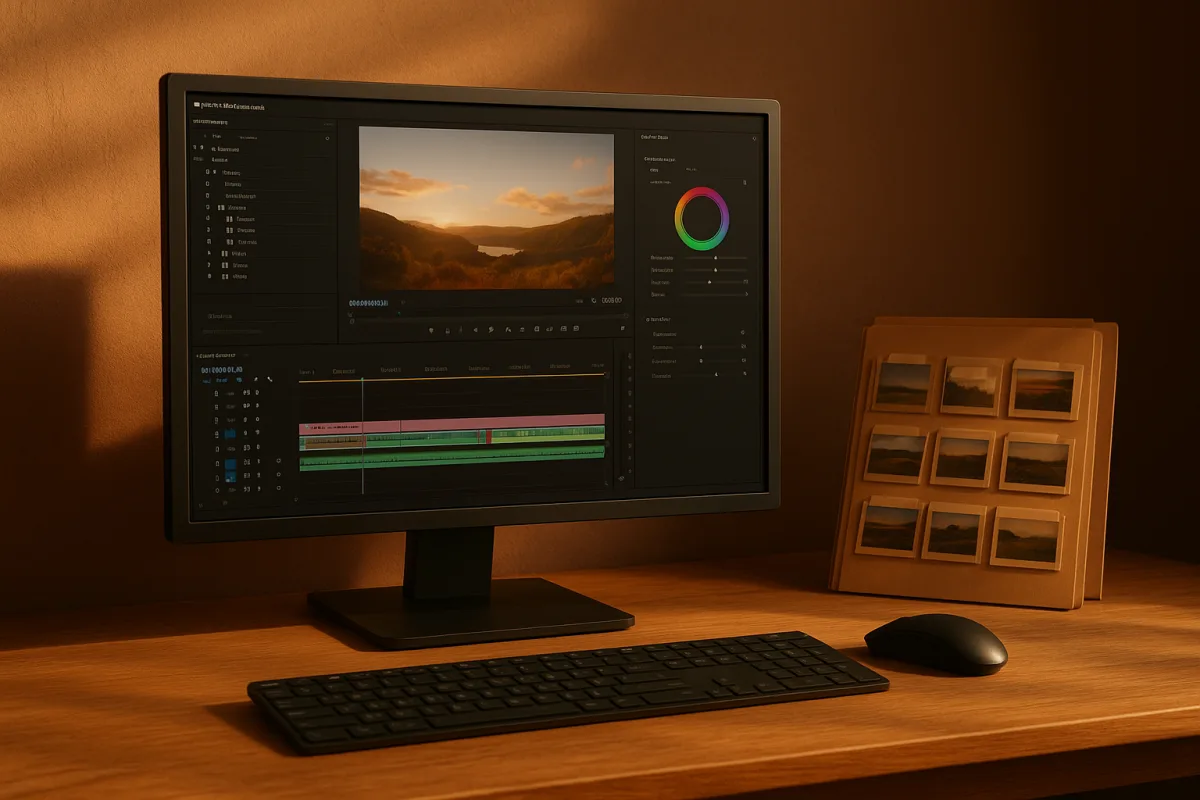
The technique: one master edit, several controlled versions
The most useful corporate-video editing technique is not a transition, an AI button or a camera upgrade. It is a versioning system: one protected master edit, with separate timelines for every approved aspect ratio, duration and delivery codec.
Corporate work rarely ends with a single 90-second film. The same interview may need a widescreen website version, a vertical social cut, a square internal-post version, a short paid-ad variant and captions burned into one regional delivery.
Trying to make all of those versions inside one constantly changing sequence is how approval mistakes happen. A lower third disappears in the vertical crop, a client-approved line is shortened accidentally, or an export inherits a social crop intended only for one platform.
Start with a 16:9 master sequence at the delivery resolution agreed during pre-production. Full HD is 1920 by 1080, while 4K is 3840 by 2160, and both remain standard 16:9 choices for conventional corporate delivery.[4][5]
The master timeline should contain the editorial decision that everyone is approving: the selected takes, message order, music structure, graphics timing, legal language and primary grade. It is the source of truth, not merely the first format exported.
Once that master is approved, duplicate it into clearly named deliverable sequences. A practical naming pattern is CLIENT_PROJECT_16x9_MASTER, CLIENT_PROJECT_9x16_SOCIAL and CLIENT_PROJECT_1x1_SOCIAL, followed by version and date.
This sounds administrative, but it saves the expensive hour late in the job. When feedback says “replace the customer quote everywhere,” an editor can identify the approved master, update it deliberately, then propagate the relevant change to each derivative timeline.
The derivatives are not automatic exports. A 9:16 frame changes composition, graphic placement and sometimes the cut itself. A wide interview with two people can work in 16:9, then become unreadable when reframed vertically without punch-ins or a new edit.
Vertical 9:16 and square 1:1 formats increasingly matter for social platforms, although 16:9 remains the dominant corporate format for websites, presentations and longer video. The correct deliverables still depend on client, platform and regional expectations.[6][7]
That is why the edit should be built for message first, not for a universal crop. Keep important faces, captions and branded graphics away from the extreme edges of the 16:9 master, but do not promise that “safe framing” eliminates re-editing.
What the timeline system actually contains
A reliable master timeline starts before the first cut. Create a consistent project folder structure for camera originals, audio, graphics, project files, proxies, exports and client-supplied materials, then apply clip names that can survive a handoff.[11]
The point is traceability. If a communications manager asks whether a sentence came from Interview B or a factory shoot two months earlier, you need to find the original clip and its associated release, not search through a folder of “FINAL_final_3.mov.”
Edit from fast local NVMe storage where possible, and archive completed project media separately on external drives.[11][20] This is workflow infrastructure, not glamorous hardware, but it determines whether the timeline stays responsive as versions multiply.
Use bins or folders that reflect decisions editors actually make: interviews, b-roll, graphics, music, approved selects and client review exports. Avoid organising only by camera card, because the person making a late corporate revision thinks in messages, departments and spokespeople.
Keep the master sequence at the footage’s native frame rate whenever possible. Common production rates include 24, 25, 30, 48, 50 and 60 fps, and unnecessary frame-rate conversion can introduce motion problems that look like a camera fault.[5]
This advice matters especially for multinational corporate work. A 25 fps interview and 30 fps screen recording can coexist, but the sequence frame rate must be chosen consciously, with the final delivery requirement decided before extensive graphics and finishing work begin.
Proxies are the practical fix, not a magic fix
Proxies are lightweight copies of camera originals that an NLE swaps in during editing. The editor cuts, trims and reviews lower-resolution media, while the software reconnects to full-resolution originals for colour, finishing and export.[10]
For 4K corporate footage, 720p or 1080p proxies are a sensible starting point.[10] They reduce the decoding burden enough for ordinary editorial decisions while retaining enough detail to judge performance, framing, focus and basic continuity.
The proxy workflow does not mean converting everything permanently to low quality. Originals remain the master assets. A proxy is a working representation linked to the original clip, which is why disciplined folder paths and media management matter.
Generate proxies after ingest, before the assistant editor or lead editor begins heavy selection. Doing it halfway through a rushed assembly creates confusion over which clips are attached, which are offline and whether review exports used originals or proxy media.
A proxy codec should favour easy playback over tiny files. The exact option depends on the NLE and operating system, so do not copy someone else’s preset blindly. Test one camera clip, confirm relinking, then batch-create the rest.
Adobe Premiere Pro, Final Cut Pro and DaVinci Resolve all support proxy-style workflows, but the buttons, attachment logic and media-management tools differ. This is one area where advice must be NLE-specific, not presented as a universal keyboard shortcut.
The problem proxies solve is compressed-source playback, particularly with 4K H.264 or H.265 footage. They do not repair a nearly full internal drive, slow external storage, insufficient RAM or a project overloaded with heavy effects and multicamera angles.[10][20]
A mid-range editing computer is commonly budgeted around $1,500 to $2,000, while a professional system is often estimated at $3,000 to $4,000.[20] Those figures cover the computer, not necessarily colour monitoring, backup storage, software subscriptions or labour.
That distinction matters when a client says their in-house team “just needs proxies.” The files help, but a proxy workflow still needs storage space for originals and proxies, time to generate them, someone responsible for relinking, and a reliable archive.
Colour belongs in the master, with exceptions documented
Do primary colour correction in the master sequence, where every derivative can inherit a consistent baseline. Corporate grading is usually less about creating a look than keeping skin tones natural, branded colours stable and locations visually coherent.[13][14]
The standard SDR target is Rec. 709 using 2.2 or sRGB gamma.[13] That gives clients and audiences a broadly reliable result across normal displays, provided the grade is checked on a properly calibrated monitor.
A colour-accurate monitor is typically budgeted at $300 to $800, and a Delta E below 2.3 is the cited calibration target for dependable colour work.[13][20] This is more valuable than grading by eye on an uncalibrated laptop.
Do not grade a corporate film into Rec. 2020 simply because the camera recorded a wide-gamut image. Rec. 2020 uploads without HDR metadata can appear washed out during SDR playback, which is a delivery mistake, not a creative choice.[13]
The derivative timelines may need crop-specific corrections. A logo that sits over a bright wall in 16:9 might overlap a face after a vertical reframe. Fix that locally, label it clearly, and do not quietly alter the approved master grade.
Brand consistency also means resisting over-saturation. The briefing’s guidance is straightforward: preserve natural skin, match shots, use brand colours carefully and ensure that an office, factory floor and interview setup feel part of the same production.[13][14]
Codec choices happen at export, not by habit
Export codec decisions are part of the versioning system because the same edit may need several files. H.264 remains the safest broad-compatibility option, particularly when a client may play the file on older devices or unknown internal systems.[8]
For high-quality 1080p delivery, the briefing recommends roughly 5 to 8 Mbps. For 4K, it recommends 20 to 30 Mbps.[8] These are starting points, not guarantees, because motion, graphics detail and platform recompression affect the result.
H.265, also called HEVC, generally delivers better compression efficiency than H.264 and is useful for supported 4K or HDR delivery.[8] Its limitation is compatibility: older devices and some corporate review systems may not decode it reliably.
AV1 is growing, and TV Technology reports that it powers 30 percent of Netflix streaming.[9] That does not make it a default corporate handoff codec, because adoption and device support still vary across regions, clients and platforms.
The practical answer is to ask where the file will live. A 4K H.265 master for a supported streaming platform and an H.264 review file for a client portal can both be correct, provided their names make the distinction obvious.
Costs, software and AI responsibility
Software choice changes the budget but not the need for controlled sequences. Adobe Premiere Pro is listed at $22.99 per month and suits teams needing a subscription-based professional NLE and integrated Adobe workflow.[22]
Apple’s Final Cut Pro costs $299.99 as a one-time purchase and suits editors working in Apple-centric environments who prefer that purchasing model. DaVinci Resolve Studio costs $295 once and suits workflows that need a professional NLE with strong integrated finishing tools.[20]
I have not tested these applications for this article, so those are category-based recommendations rather than personal product reviews. Test the proxy, caption, colour-management and export workflow your team needs before committing a live corporate job to it.
AI tools inside Adobe Premiere Pro and DaVinci Resolve can speed up transcription, searchable dialogue, rough assembly and some repetitive tasks.[12] They are useful where the bottleneck is locating usable material, not where the bottleneck is judgement.
An AI tool cannot know which executive statement is politically safe, which customer soundbite needs legal review or whether a creator-style social cut matches a conservative client’s brand. Those remain editorial and stakeholder decisions.[3][17]
Creator-style authenticity is increasingly favoured by younger audiences, but polished corporate production remains appropriate for many clients and regions.[1][3] The master-and-derivatives system supports both, because the message can stay approved while pace, framing and presentation change by audience.
Frequently Asked Questions
What are the best video editing techniques for corporate videos?
The most effective technique is to create one approved 16:9 master timeline that contains the final editorial decisions, then duplicate it into separate timelines for each required aspect ratio and deliverable. This avoids mistakes from resizing a single sequence and allows tailored edits for vertical, square, or other formats. Organizing clips by message and using a consistent folder structure also supports efficient editing and traceability.
How do I manage multiple deliverables in corporate video editing?
Start with a protected master edit in the agreed delivery resolution and aspect ratio (usually 16:9). Then create clearly named derivative timelines for each additional format, such as vertical (9:16) or square (1:1). This system enables deliberate updates to the master that can be propagated to all versions, maintaining consistency and reducing errors in client revisions.
What proxy settings work best for 4K corporate video editing?
Generate proxies at 720p or 1080p resolution linked to the original 4K footage. However, proxies cannot compensate for slow storage or insufficient RAM, so both proxies and originals should reside on fast local NVMe drives to ensure smooth editing performance.
How should I organize timelines for different aspect ratios in corporate videos?
Use one master timeline in 16:9 at the delivery resolution to finalize editorial decisions, then duplicate it into separate timelines for each aspect ratio needed. Name these timelines clearly to reflect their format and purpose, such as CLIENT_PROJECT_9x16_SOCIAL, to keep versions distinct and manageable.
Which codecs are recommended for corporate video delivery?
H.264 is recommended when broad compatibility is essential, while H.265 (HEVC) is preferred for 4K or HDR deliveries on supported platforms. AV1 is gaining adoption but is not yet universally supported, so it should not be assumed as a default codec for corporate clients.
How we researched this
This article was assembled from 24 cited references.
Nothing here is based on hands-on testing. Where a figure or finding appears, it belongs to the source cited beside it, and the writing says so rather than implying otherwise. Every source is listed below so you can check it.
Sources
- What Are the Latest Trends in Corporate Video Production – 2026 - VerboLabs
- Top Corporate Video Production Trends (2026) - INSCMagazine
- Corporate Video Trends in 2026: What Has Changed
- YouTube Video Size (2026): Resolution & Aspect Ratio Guide | Linklay
- Best YouTube Video Settings 2026: Resolution & Frame Rate Guide
- Video Aspect Ratios Explained for Product Demos (2026) | Poko
- Best aspect ratios for video in 2026 | Convertitive
- Compress Video Without Losing Quality - Guide 2026
- AV1 Open Video Codec Now Powers 30% of Netflix Streaming
- Proxy workflows: editing 4K footage without a monster machine | Miami Video Services Blog
- Video Editing Workflow: How to Create an Efficient Process
- Hollywood darling of video editing software gets AI assistants and expanded photography features in big update
- Color Grading Tips for Corporate Content 2026 | Leumos AI
- Achieving Visual Consistency Across Factories in Corporate Videos | ONCE
- What is colour grading? Everything you need to know
- What Is Color Grading? A Complete Guide for Video Producers (2026) | Ruah Creative House
- Corporate Video Production: 2026 Complete Guide
- Corporate Video Trends 2026 | Top Pup Media
- Corporate Video Production Trends Brands Are Using in 2026 - Welcome to Get Right Media | Get Right Media
- Video Editing Hardware Guide 2026: What You Really Need – EncodeX Blog
- The True Cost of DIY Video Editing (Time, Money, Opportunity) | Remote Video Editing Agency | Color Grading | Editorial | Post Production | Motion Graphic | Animation
- Adobe Premiere Pro Price 2026: Best Video Editors | BizTechScout
- Corporate Video Production: The Complete 2026 Guide
- Colour Grading in Corporate, Commercial and Training Videos - SID Video
Related Articles
Travel Vlog Video Editing: Workflow, Proxies & Colour Tips
Learn travel vlog video editing with tips on workflow, proxies, colour grading, and pacing to create engaging travel videos efficiently.
Edit Video for Live Events
Learn how to edit video for live events with tips on timelines, proxies, codecs, syncing, and color grading for smooth, efficient post-production.

Unlocking Hidden Insta360 App Features: A Comprehensive Tutorial
Discover hidden features in the Insta360 app version 2, including framing guides, proxy mode, navigation shortcuts, MultiView, photo-to-video conversion, color correction, and customizable export settings. Master the art of reframing shots with this detailed tutorial.
Edit Video for Educational Content
Learn how to edit video for educational content with tips on timelines, proxies, codecs, and color correction for engaging teaching videos.