
Video Editing for Non-Profits: Tips, Tools, and Workflow
Learn video editing for non-profits with tips on timelines, proxies, codecs, and free tools to create effective fundraising and social videos.
Start with the audience action, not the footage
A non-profit edit usually arrives with too much material and too many stakeholders. Before opening the NLE, write one line defining what the viewer should do: donate, register, volunteer, attend, or share.
That line is the test for every interview answer, B-roll shot and graphic. If a clip is moving but does not help the viewer understand the need, the organisation’s response, or the next action, it belongs in selects, not the first cut.
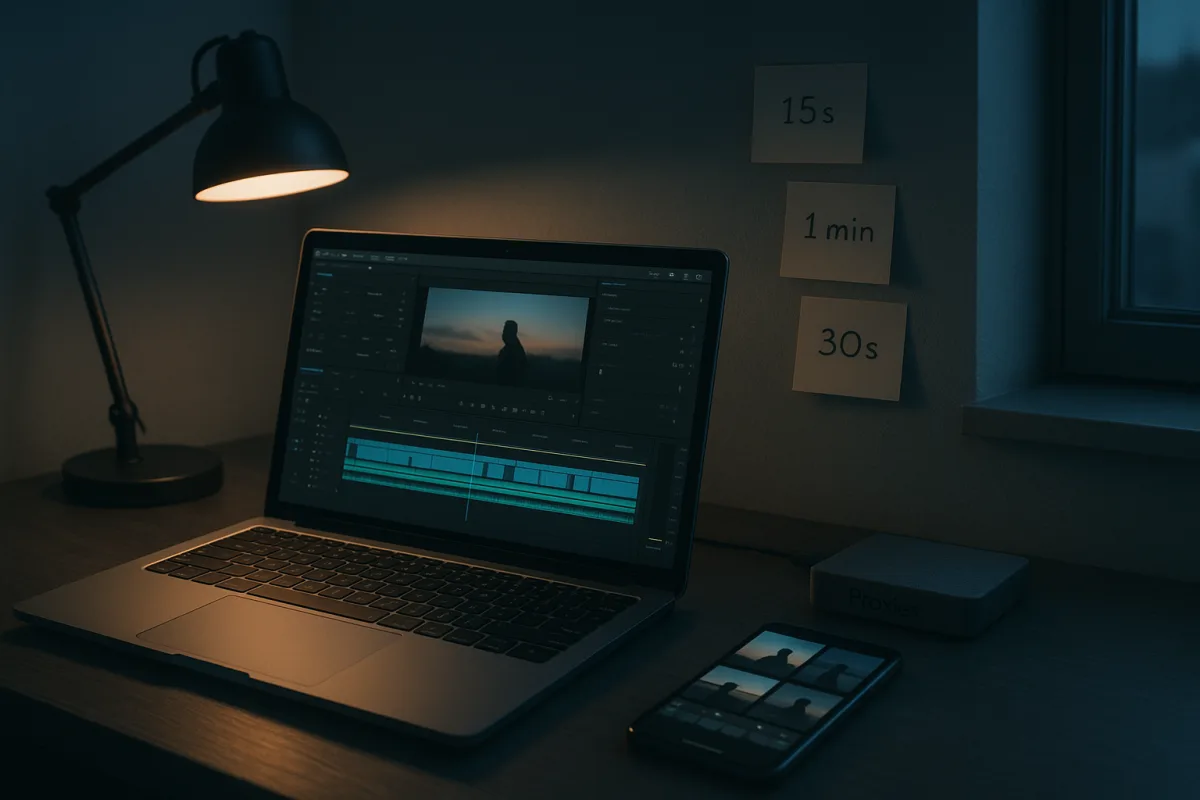
Do not cut one master and assume it will work everywhere. The research on social-video length points to different practical ranges: 15 to 30 seconds for Instagram Reels and TikTok, 30 to 60 seconds for YouTube Shorts, and 60 to 120 seconds for Facebook and LinkedIn feeds. [11]
For a website hero, aim for 60 to 90 seconds rather than a three-minute organisation history. [7] Landing-page engagement is reported at roughly 55 percent for videos under 30 seconds, dropping below 50 percent beyond 120 seconds. [12]
That does not mean every story needs to be compressed into a slogan. It means the edit needs a purpose-built opening, with the donor or volunteer action appearing early when a video runs longer than 90 seconds. [13][21]
Organise the project before a deadline turns it into archaeology
Make a project folder with separate Original Media, Audio, Graphics, Proxies, Exports and Documents folders. Keep the camera-card folder structure inside Original Media where possible, rather than scattering renamed clips across desktops and download folders.
Create a simple spreadsheet or document that records contributor name, location, date, consent status, music licence, stock licence and any restrictions on use. This matters most when a campaign will run across platforms, territories or future fundraising rounds.
Build bins around editorial use, not camera technicalities alone. A workable starting point is Interviews, B-roll, Events, Archive, Still Images, Logos, Music, SFX and Approved Graphics, with stringouts or selects timelines for the usable material.
When people are sharing footage from phones, cameras and messaging apps, inspect frame rate, orientation and resolution before cutting. Mixing vertical clips into a horizontal timeline is manageable, but it is better to decide whether the primary deliverable is 16:9 or 9:16 first.
Pick an editor that fits the job and the team
For zero software spend, DaVinci Resolve is the most feature-heavy option in this group. Its free version has no watermark or time limit, and Resolve 21 adds a Photo page for RAW image grading, although that new page is not a reason to complicate a straightforward fundraising edit. [2][3]
Kdenlive is free, open-source and has robust proxy support, making it a sensible choice for an organisation editing higher-resolution footage on modest computers. [15][22] It suits teams that need a proper timeline workflow without a subscription budget.
Shotcut is another free, no-watermark and no-time-limit editor. [3][4] It suits a volunteer or small communications team that needs straightforward trimming, titles and exports, rather than a deeply managed collaborative post-production environment.
CapCut is also listed among the established free no-watermark, no-time-limit options. [3][4] It suits short-form social edits, especially when the needed deliverable is a fast vertical cut, but establish ownership and file handoff rules before several volunteers begin editing separately.
OpenShot is the remaining free option in this field, again without a watermark or time limit. [3][4] It suits basic assemblies and simple social deliverables where the team needs an accessible editor rather than an advanced finishing workflow.
Adobe Premiere Pro supports proxy editing, but it is commercial software and the supplied research does not establish a current non-profit price. [15] Do not budget from an assumed discount. Confirm the organisation’s actual licensing eligibility and renewal cost before standardising on it.
I have not tested each of these applications, so this is not a performance ranking. The practical choice is the editor one staff member can operate reliably, can reopen next month, and can export from without losing the original media links.
Make proxies before blaming the computer
A proxy is a lower-resolution, lightly compressed copy of the original camera file. The editor cuts with the proxy for smooth playback, while the final export uses the full-resolution originals. [14]
The basic sequence is uncomplicated: import and back up the original footage, generate proxies in the editing application, turn proxies on while cutting, then relink or switch back to originals before the final render. [14][16]
This is particularly useful when a small organisation receives 4K footage but edits on an older laptop. A lagging timeline is often a codec-and-workflow problem, not proof that the organisation needs a costly workstation immediately.
Keep proxy files in the project folder and do not rename originals after proxy creation. If the final export looks soft, blurry or unexpectedly low resolution, stop and verify that the NLE has switched back to original media.
Kdenlive, DaVinci Resolve and Adobe Premiere Pro are specifically identified as supporting proxy workflows. [15][22] The exact buttons differ by version, so use the documentation for the installed version rather than copying instructions written for another NLE.
Cut the story before adding polish
Start with a radio edit: dialogue, natural sound and the call to action. A fundraiser does not need every good quote. It needs the smallest number of honest lines that explain who is affected, what the organisation does and how the audience can help.
Then cover jump cuts with B-roll that adds information. Show the service, the people involved, the place and the outcome. Avoid using generic images simply because there is a gap in the timeline, especially when the subject needs dignified representation.
Make captions part of the edit, not a final upload chore. Keep on-screen donor instructions long enough to read, and make the URL, QR code or event date large enough to survive mobile playback and platform compression.
Create a clean master timeline, then duplicate it for each channel. Reframing a 16:9 interview for 9:16 is editorial work: check headroom, move lower thirds, and make sure the key action is not hidden by platform interface elements.
License music and stock before publishing
Do not treat “non-profit” as permission to use a commercial song. The rights question covers platform, territory, duration, exclusivity, model or property releases, and potentially continuing music royalties. [17][18]
For recurring work, Artlist, Epidemic Sound and Musicbed are royalty-free subscription options. The research places unlimited-access music subscriptions at $200 to $500 per year, but does not assign an exact current price to each service, so check the plan’s organisational and campaign terms. [17]
A single music-track licence can cost $50 to $2,000, while a custom composition is cited at $500 to more than $10,000. Well-known songs can run from $5,000 to more than $500,000 depending on artist and use. [17]
For stock footage, Pexels and Pixabay are free or low-cost sources, while Storyblocks is grouped with them in the research, primarily for non-commercial or personal use. [18] Read the current licence on every downloaded asset, particularly for paid promotion.
Artgrid, Adobe Stock and Shutterstock occupy the mid-tier range cited at £20 to £2,000 per clip, with subscriptions at roughly £30 to £200 per month. [18] Those are category ranges, not a quoted price for every clip or plan.
Getty Images and Pond5 are listed as premium stock sources, beginning at about £200 per clip and reaching £2,000 or more for broadcast or exclusive rights. [18] Their higher cost can be justified for a specific missing shot, but it should not become the default visual strategy.
Save the licence receipt, asset ID, permitted platforms and expiry information with the project. That small administrative step can save hours when a campaign is reused, boosted, translated or questioned after the original editor has moved on.
Grade for credibility, not artificial emotion
A non-profit video can use colour to support the story, but colour cannot manufacture trust. Warm amber, gold and orange palettes are associated with comfort, intimacy and nostalgia, while cooler blue, teal and grey treatments can suggest seriousness or melancholy. [20]
The safer starting point is correction, not a heavy preset. Balance exposure and white balance between shots, keep skin tones natural, and match interviews so a person does not visibly change colour every time the camera angle changes. [20]
Natural skin tones are especially important for viewer connection. [20] If warming the grade makes faces orange or pushes white shirts yellow, pull it back. The person on screen matters more than a fashionable teal-and-orange look.
There are no documented presets designed specifically for non-profit storytelling in the research. Use a restrained warm adjustment only when it fits the material, and keep the grade consistent through the film to support narrative cohesion and trust. [23]
Export for the viewer’s connection, not the edit suite
For the dependable main deliverable, export an MP4 container with H.264 video. It remains the standard recommendation for compatibility, while H.265 can offer better compression but has more limited device support. [5][6]
Use 1920 by 1080 at 30 fps as the default balance of quality and manageable file size. A typical 1080p target bitrate is 5 to 8 Mbps, with AAC audio at 48 kHz and 192 to 320 kbps. [6][8]
Use 16:9 for standard website, YouTube and general horizontal delivery. Make a separate 9:16 export for Reels and Stories rather than relying on a platform crop, since Instagram favours vertical 9:16 presentation. [7][9]
4K is supported by Vimeo and YouTube, but it is often unnecessary for a fundraising campaign. [7] At 20 to 30 Mbps, a 4K export also creates a heavier upload and download burden than most 1080p distribution needs justify. [6]
If the campaign reaches audiences with constrained internet access, make a lower-resolution or lower-bitrate version. At 5 Mbps, 1080p is approximately 60 MB per minute, while a 10-minute 4K file can reach roughly 2 to 3 GB. [6][19]
Where the hosting setup permits it, adaptive bitrate streaming can adjust playback quality to the viewer’s available bandwidth. [1] That is more useful than insisting every viewer receives the largest possible file, especially for outreach across varied networks and devices.
Frequently Asked Questions
How do I edit videos effectively for a non-profit organization?
Start by defining one clear viewer action, such as donate or volunteer, and use this to guide your selection of clips. Organize your project with separate folders for media types and create bins based on editorial use. Inspect footage for frame rate and orientation before editing, and tailor edits to platform-specific video lengths and formats.
What free video editing software is best for non-profits?
DaVinci Resolve offers a feature-rich free version without watermarks or time limits, suitable for professional edits. Kdenlive is a good open-source option with strong proxy support, ideal for modest computers. Shotcut and CapCut are simpler free editors that work well for small teams or volunteers needing basic trimming and titles.
How can non-profits use proxies to edit 4K footage on low-end computers?
Create lightweight proxy copies of your 4K footage to avoid stuttering during editing. Edit these proxies instead of the original files, then reconnect the original high-resolution files before exporting the final video. Kdenlive is noted for robust proxy support, making it a sensible choice for this workflow.
What video lengths work best for social media videos for non-profits?
For Instagram Reels and TikTok, keep videos between 15 to 30 seconds. YouTube Shorts perform best at 30 to 60 seconds, while Facebook and LinkedIn feeds suit 60 to 120 seconds. Website hero videos should aim for 60 to 90 seconds to maintain viewer engagement.
How should non-profits organize video projects before editing?
Create a project folder with subfolders for Original Media, Audio, Graphics, Proxies, Exports, and Documents. Maintain the camera-card folder structure within Original Media and keep a document or spreadsheet tracking contributor details, consent, and license information. Organize clips into bins by editorial use like Interviews, B-roll, and Music rather than by technical file type.
How we researched this
This article was assembled from 23 cited references.
Nothing here is based on hands-on testing. Where a figure or finding appears, it belongs to the source cited beside it, and the writing says so rather than implying otherwise. Every source is listed below so you can check it.
Sources
- BOLA: Near-Optimal Bitrate Adaptation for Online Videos
- DaVinci Resolve 21 (2026) review: Our top free video editing app gets big improvements and a new Lightroom-style Photos tool for color-grading images
- Best Free Video Editing Software No Watermark 2026 | VaiFlux
- Best Free Video Editors in 2026 — Easy Video Delivery
- Best Video Format for Social Media in 2026
- Compress Video Without Losing Quality - Guide 2026
- Vimeo Video Specs in 2026 (Resolution, Bitrate, Codec) | UniLink Blog
- Résolution et formats vidéo pour écran LED : guide technique complet 2026 | Blog Pixelight
- Best Video Formats for Social Media in 2026 (Complete Guide) | FluidConvert
- Facebook Video Format, Size & Upload Limits (2026 Specs)
- The Impact of Social Video Length on Conversion Rates: Insights from Moindes Limited | IssueWire
- Landing Page Video Benchmarks 2026 + Free ROI Calc
- How to Choose the Right Marketing Video Length for Any Goal | Wistia
- Proxy workflows: editing 4K footage without a monster machine | Miami Video Services Blog
- AI Video Editing for Low-End PCs (2026 Guide) - TheEditFlows
- The Ultimate Guide To Proxy Workflows For Enterprise - MASV™
- Rush Fees, Raw Footage, Buyouts: Video Production Pricing Terms Decoded
- Stock Footage Cost Guide 2026 | UK Rates & Licence Types
- Video Resolution Explained: 1080p, 4K, 8K Sizes & How to Upscale (2026)
- Colour grading in videography: a practical guide
- How Long Should A Corporate Video Be in 2026? | Story Machine
- Video and streaming | SnipeOS
- How Colour Grading Shapes Emotion in Video | Reverie Films
Related Articles
Video Editing Techniques for Corporate Videos
Learn effective video editing techniques for corporate videos, including timelines, proxies, codecs, and color grading best practices.
Travel Vlog Video Editing: Workflow, Proxies & Colour Tips
Learn travel vlog video editing with tips on workflow, proxies, colour grading, and pacing to create engaging travel videos efficiently.
Edit Video for Live Events
Learn how to edit video for live events with tips on timelines, proxies, codecs, syncing, and color grading for smooth, efficient post-production.
How to Edit Video for Online Courses: Best Practices
Learn how to edit video for online courses with tips on timelines, proxies, codecs, color correction, and lesson structuring for effective learning.