
How to Choose the Right Video Editing Headphones
Learn how to choose the right video editing headphones for accurate monitoring, comfort, and isolation during long editing sessions.
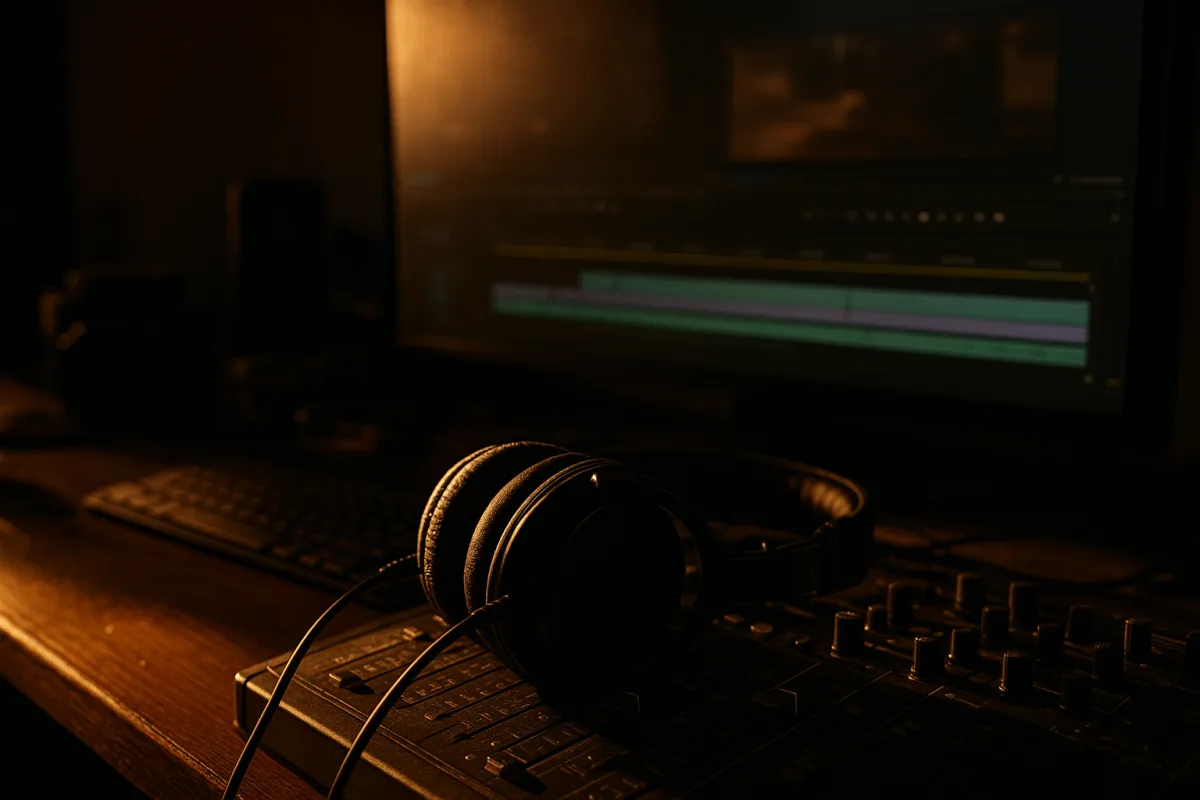
The decision: Sony MDR-7506 or Røde NTH-100?
For a working video editor, this is not really a contest between “good” and “bad” headphones. It is a decision between the cheaper Sony MDR-7506 and the more comfort-led Røde NTH-100, both closed-back wired options aimed at monitoring rather than casual listening.
My call is straightforward: buy the Sony MDR-7506 when budget, portability and dependable isolation are the job. Buy the Røde NTH-100 when you routinely spend long days editing and headphone discomfort is costing concentration before the timeline is finished.
They are close where it matters most: both are closed-back designs, both cover the conventional audible range, and neither should be treated as a final authority on a mix without checking the work on speakers and another playback device. I have not handled or tested either model, so this judgement rests on the published specifications and reported use cases, not personal listening.
Why accurate monitoring is not the same as impressive sound
The thing that saves an hour in post is hearing the bad edit, abrupt room-tone change, clipped consonant or low HVAC rumble before export. A flattering bass lift or an artificially bright top end can make that harder, even if it makes music feel exciting.
For editing, look for a reasonably neutral response that covers at least 20 Hz to 20 kHz. Published extension below or above that range is not automatically useful. The Sony MDR-7506 is listed with a 10 Hz to 20 kHz response, while the Røde NTH-100 is listed at 5 Hz to 35 kHz.
Those figures confirm broad coverage, but they do not show how flat either headphone is across that range. [6][15]
That distinction matters. A headphone can quote 5 Hz or 35 kHz and still present parts of the audible spectrum unevenly. Do not buy on the longest frequency-response line on the box. Buy for the monitoring environment, comfort, connection and known suitability for controlled listening.
Sony MDR-7506 versus Røde NTH-100
| Criteria | Sony MDR-7506 | Røde NTH-100 |
|---|---|---|
| Position in the field | Entry-level option, the lower-cost choice of these two | Mid-range option, a step up in cost from the Sony |
| Design | Closed-back wired monitor headphone | Closed-back wired monitor headphone |
| Published frequency response | 10 Hz to 20 kHz [6] | 5 Hz to 35 kHz [15] |
| What the response figure means | Covers the standard monitoring range, but does not by itself prove a flat response | Extends beyond the standard monitoring range, but extension does not by itself prove neutrality |
| Isolation and leakage | Closed-back construction suits noisy rooms and shared workspaces | Closed-back construction suits noisy rooms and shared workspaces |
| Reported sound use | Reported as reliable and accurate for budget-conscious editors [6] | Positioned for neutral sound during extended editing sessions [15] |
| Comfort case | Reported as durable and comfortable for extended use, but with no clamping-force figure supplied here [6] | Heat-dissipating earcups are the clearest published comfort differentiator [15] |
| Long-session risk | Better value if the fit works for you, but fit remains personal | Better bet when heat and fatigue are recurring problems |
| Device compatibility | Verify impedance and sensitivity against your interface before buying | Verify impedance and sensitivity against your interface before buying |
| Best use | Budget edit bay, travel kit, assistant station, noisy office | Long-form editing, dialogue work and regular full-day headphone sessions |
| Main limitation | Less emphasis on premium comfort features | Costs more without published evidence here that it is categorically more neutral |
1. Frequency range: neither number picks the winner
The Sony MDR-7506 reaches from 10 Hz to 20 kHz, which includes the standard range relevant to normal monitoring. The Røde NTH-100 is quoted at 5 Hz to 35 kHz, extending lower and higher on paper. [6][15]
The Røde wins only if you judge by endpoints, and that is not how I would make the purchase. For editing spoken-word clips, social work, corporate interviews or documentary assemblies, a believable midrange and controlled presentation matter more than reproducing frequencies beyond normal hearing.
There is no supplied response graph, distortion measurement or independent side-by-side measurement here that establishes one as flatter than the other. Calling the Røde more accurate solely because it reaches 35 kHz would be false precision.
2. Isolation: this is a draw, and that is useful
Both choices are closed-back. That means the decision works for the common real-world edit environment: an office with people nearby, a location desk, an assistant editor beside production sound, or a home workspace with appliances running.
Closed-back headphones reduce the amount of external noise reaching your ears and limit sound leaking into microphones. Open-back headphones generally offer a more spacious presentation, but their leakage and weak isolation make them unsuitable for many editing situations. [8]
This is where otherwise sensible advice about open-back monitoring fails. If a noisy room makes you turn the volume up, or if sound leaks into a live microphone, a supposedly more natural headphone is not delivering more accurate monitoring. It is making the environment part of the mix.
3. Comfort: the Røde has the clearer case
The Sony MDR-7506 is widely framed as durable and comfortable over extended use by Miracamp. [6] That is meaningful, particularly for an entry-level model that needs to survive being packed and unpacked rather than displayed on a desk.
The Røde NTH-100 has a more specific comfort claim: heat-dissipating earcups intended to make long wear more manageable. Digital Camera World also positions it around comfort and neutral sound for extended sessions. [15]
That makes the Røde my choice for an editor who routinely spends six to ten hours in headphones. Heat buildup and pressure do not sound like audio issues until hour five, when the sensible correction is suddenly the one that gets the cut out the door.
Still, comfort is the least universal category in this comparison. A sensible benchmark is roughly 3 to 5 newtons of clamping force and a weight below about 300 grams, but the supplied material does not provide equivalent figures for these two models. Try before buying where possible, or buy from a retailer with a practical return policy.
4. Connection and amplification: verify before assuming
For ordinary computers, compact interfaces and small mixers, low-impedance headphones, roughly 16 to 32 ohms, with sensitivity above 100 dB SPL/mW are the safer pairing. Higher-impedance models can need more voltage than a laptop or small interface supplies cleanly.
The field identifies the Beyerdynamic DT 770 Pro specifically as an 80-ohm variant, but it does not provide comparable impedance or sensitivity details for the Sony MDR-7506 or Røde NTH-100. [6] Do not infer those figures from their category or price position.
Before ordering, check the current manufacturer specification against the headphone output you actually use. This is a workflow check, not a gear-status exercise. Under-driven headphones can leave you monitoring too quietly or turning a poor output too far up.
5. Price position and value: Sony wins the constrained budget
The Sony MDR-7506 is the entry-level option in this field. The Røde NTH-100 sits in the mid-range, so it is a step up from the Sony rather than a direct bargain-bin alternative.
That makes the Sony the cleaner recommendation for a second edit station, a junior editor, a travel kit, or anyone replacing headphones that failed during a busy job. It is the choice when the requirement is dependable closed-back monitoring without spending the budget meant for storage, backups or audio cleanup.
The Røde earns its higher position only if comfort is a recurring work problem. If you edit an hour or two at a time, the premium for heat-management features may not change the outcome. If headphones stay on for most of the day, it may be the sensible spend.
Where the rest of the field sits
The Sony MDR-7506 is the entry-level closed-back option for budget-conscious editors who want reliable monitored sound. The FiiO FT1 is also entry-level and suits beginners looking for an affordable route into audiophile-oriented listening, with 60 mm drivers and a claimed balance of bass, mids and highs. [6][14]
The Audio-Technica ATH-M50x is a mid-range closed-back model for editors seeking a balance of performance and affordability, with a reported 15 Hz to 28 kHz response. The Beyerdynamic DT 770 Pro 80Ω is another mid-range closed-back option, aimed at editors who value isolation and reported long-term comfort, but its 80-ohm rating means amplification should be checked carefully. [6][16]
The Shure SRH840A sits in the mid-range for editors who want controlled, balanced closed-back monitoring. The Nothing Headphone (a) is also mid-range, but its appeal is wireless convenience, active noise cancellation and quoted battery endurance, rather than being the cleanest default choice for critical wired monitoring. [15]
For quiet rooms, the Sennheiser HD 600 is a mid-range open-back choice for editors who want a natural soundstage. The Beyerdynamic DT 990 Pro X is likewise a mid-range open-back option for critical listening, while the Sennheiser HD 490 Pro is aimed at quiet-environment editing with an open, natural presentation. [6][12][13]
At the premium end, the Sony WH-1000XM6 suits editors who need high-grade active noise cancellation and customisable sound profiles, particularly when travel or noisy environments dominate the day. Its wireless and ANC features are useful, but they add processing variables I would avoid when making final mix judgements. [10]
The FiiO FT15 is the premium choice for listeners seeking high-fidelity open, spacious sound, using 101 mm planar drivers and diamond-coated diaphragms. It is the most ambitious option in this field, but advanced driver materials do not make it a replacement for isolation in a noisy edit bay. [7]
What this does not change about video workflows
Codecs, proxies, timeline resolution and colour-management settings do not directly determine which headphones you should buy. There is no evidence in the supplied research that editing ProRes rather than H.264, or using proxy media rather than camera originals, changes the monitoring requirements.
What does change is your environment and task. Dialogue editing in a busy room needs isolation. Checking a music-led spot in a treated, quiet room can benefit from the openness of an open-back design. Final delivery still deserves checks on speakers, earbuds and a consumer device.
Who each option suits
Sony MDR-7506: Choose this entry-level closed-back model if you need the lower-cost, practical decision. It suits budget-conscious editors, assistants building a first kit, editors working in shared rooms, and anyone who needs isolation without paying for extra comfort features.
Røde NTH-100: Choose this mid-range closed-back model if editing days are long enough that heat, fatigue and concentration are the real problem. It suits editors who need isolation but are willing to spend more for the reported heat-dissipating earcup design and an extended-session focus.
The honest result is close. Neither model has enough published evidence here to claim an unconditional accuracy victory. The Sony is the better value decision. The Røde is the better comfort-led decision.
Frequently Asked Questions
How do I choose the right headphones for video editing?
Select headphones based on your editing environment, comfort needs, and monitoring accuracy. Closed-back headphones are best for noisy or shared spaces, while open-back models suit quiet rooms. Prioritize a broadly flat frequency response covering 20 Hz to 20 kHz rather than extended frequency range. Also, consider comfort features if you spend long hours editing.
What are the differences between Sony MDR-7506 and Røde NTH-100 for editing?
The Sony MDR-7506 is a budget-friendly closed-back headphone with reliable isolation and a frequency response from 10 Hz to 20 kHz, suited for noisy environments and shorter sessions. The Røde NTH-100 costs more but offers better comfort with heat-dissipating earcups, making it preferable for long editing days; it claims a wider frequency range (5 Hz to 35 kHz) but this does not guarantee greater neutrality. Both require checking impedance and sensitivity compatibility with your audio interface.
Why is headphone comfort important for long video editing sessions?
Comfort reduces fatigue and distraction during extended editing, helping maintain focus on the timeline. Features like heat-dissipating earcups, appropriate clamping force, and breathable padding improve wearability over many hours. The Røde NTH-100 is noted for better comfort in long sessions compared to the Sony MDR-7506.
Are closed-back headphones better than open-back for video editing?
Closed-back headphones are generally better in noisy or shared environments because they isolate external noise and prevent sound leakage, which can affect judgment. Open-back headphones provide a more natural soundstage and are preferred only in quiet rooms for critical listening. Using open-back headphones near recording equipment or in offices is not recommended due to leakage and outside noise interference.
What frequency range matters most in headphones for video editing?
A flat frequency response covering the standard audible range of 20 Hz to 20 kHz is most important for accurate monitoring in video editing. Extended frequency ranges beyond this do not guarantee neutrality or improved editing accuracy. Focus on how evenly the headphones reproduce sound within the audible range rather than on published frequency extremes.
How we researched this
This article was assembled from 16 cited references.
Nothing here is based on hands-on testing. Where a figure or finding appears, it belongs to the source cited beside it, and the writing says so rather than implying otherwise. Every source is listed below so you can check it.
Sources
- Best Headphones for Professional Video & Audio Editing (September 2026) Trusted Reviews
- Audio-Technica ATH-WP900SE
- 9 Best Headphones For Video Editing | Built for the Critical Ear
- Sony MDR-7506 Professional Dynamic Wired Monitor Headphones with Large – JG Superstore
- Best Headphones for Podcasting (2026): What Professionals Actually Use
- Best Headphones for Video Editing in 2026
- Our favorite budget audiophile brand launches new flagship planar magnetic headphones that aren't so budget - but a next-gen 86% thinner diaphragm with 'full-face diamond coating' could make them worth the price for head-fi fans
- Open-Back vs. Closed-Back Headphones: Which Type Is Best For You? - RTINGS.com
- "A good combination of comfort and sonics in a lightweight design": Rode NTH-50 review
- Buy SONY WH-1000XM6 Wireless Bluetooth Noise-Cancelling Headphones - Midnight Blue | CurrysIE
- beyerdynamic DT 770 PRO X Studio Closed-Back Headphones | Music & Arts
- Best Headphones for Video Editing in 2026
- The Best Headphones for Video Editing & Mixing - The Post Flow
- These budget audiophile headphones sound as good as they look
- The best headphones for video editing in 2026: high quality audio for every budget
- Beyerdynamic 250 Ohms DT770 Pro Headphones - Andertons Music Co.
Related Articles
Best Video Editing Apps for Mobile
Compare the best video editing apps for mobile in 2026, focusing on CapCut and LumaFusion features, workflows, and performance tips.
Video Editing for Non-Profits: Tips, Tools, and Workflow
Learn video editing for non-profits with tips on timelines, proxies, codecs, and free tools to create effective fundraising and social videos.
Video Editing Chair: How to Choose the Right One for You
Learn how to choose the right video editing chair with expert comparisons and ergonomic tips for long editing sessions.
Video Editing Techniques for Storytelling: Pacing & Rhythm
Learn video editing techniques for storytelling, focusing on pacing, shot length, and rhythm to enhance narrative impact.