
Video Editing Techniques for Storytelling: Pacing & Rhythm
Learn video editing techniques for storytelling, focusing on pacing, shot length, and rhythm to enhance narrative impact.
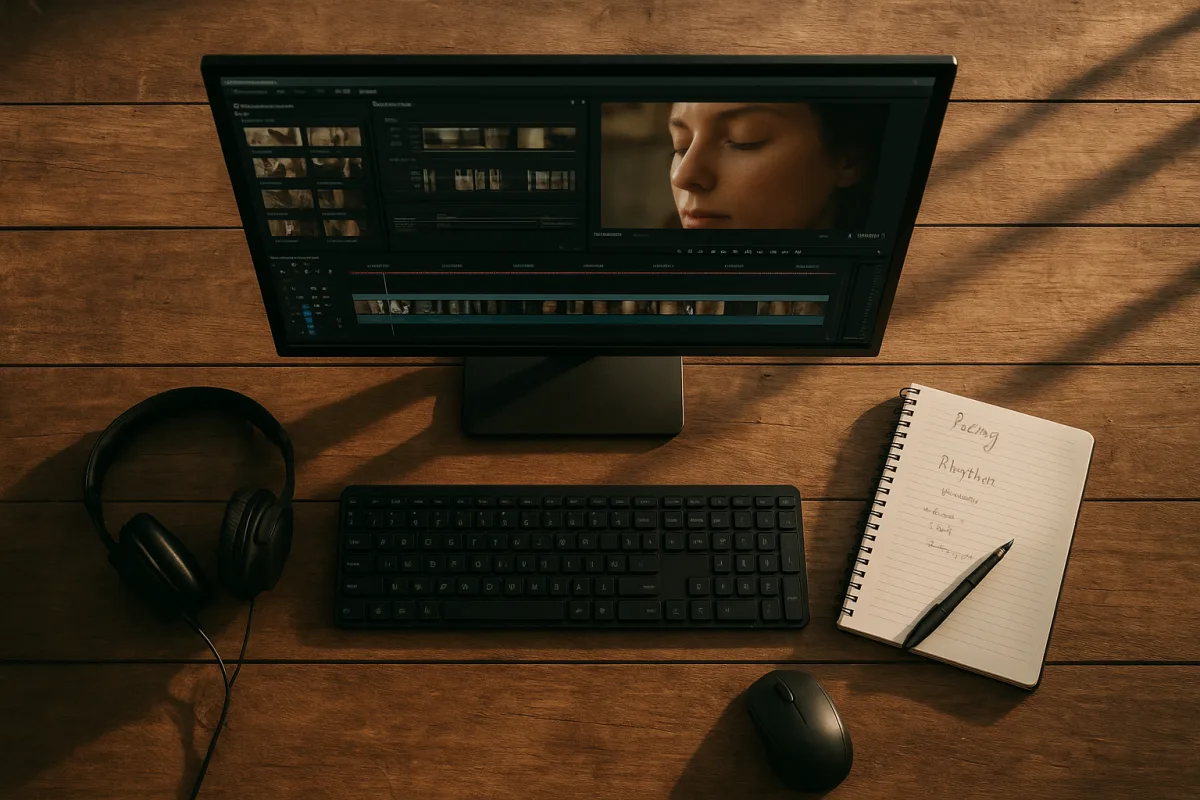
Storytelling lives in the change of pace
The most useful editing technique for storytelling is rhythmic pacing: controlling when the viewer receives new information, when they are allowed to absorb it, and when a cut interrupts that absorption.
Editors often reduce pacing to average shot length, or ASL. It is a useful number, but it is not the story. Two films can average three seconds per shot while feeling entirely different.
One may cut every three seconds with metronomic regularity. The other may hold a seven-second close-up after a confession, then cut through six fragments in four seconds as a character leaves the room.
The second version has rhythm because it changes speed in response to meaning. That variation tells the audience, often without dialogue, which moments are routine, which are dangerous, and which deserve emotional space.
FilmDaft describes cuts under one second as capable of creating urgency, while shots held for five seconds or more can create calm or tension. [5] The important word is “can.” Duration has no fixed emotional meaning outside the scene.
A five-second wide shot can feel peaceful if the audience understands the space and has time to observe it. The same five seconds can be unbearable if the audience is waiting for someone to enter through a door.
Average shot length is the measurement, not the edit
ASL is simple: divide the total running time of a sequence by its number of shots. A 60-second scene containing 20 shots has an ASL of three seconds.
That figure is helpful when a cut feels sluggish, frantic or strangely flat. It gives the editor a way to compare sequences, versions and deliverables without pretending that a single number can define good storytelling.
The failure is treating ASL as a preset. If every shot in that 60-second scene is exactly three seconds, the viewer learns the pulse quickly. The cuts stop carrying emphasis because every beat has equal weight.
A useful rhythm has contrast. Short shots create pressure or deliver detail. Longer shots let a performance land, establish geography, reveal a reaction or let the audience anticipate an outcome.
OurStoria’s frame-by-frame analysis of wedding films reported an ASL of about 2.8 seconds, with high shot-length variation, alongside a 5.9 out of 7 emotional-impact score and 74 percent engagement. [6]
That is an interesting data point, not a universal prescription. Wedding films are built around recognisable emotional peaks, such as preparation, vows and speeches, and their audiences often arrive ready to invest emotionally.
A courtroom scene, a comedy, a travel film and a TikTok product clip do not ask for the same rhythm. The number matters because it describes an observed pattern, not because 2.8 seconds is secretly the correct duration.
Cut on a change, not because the clock says so
When cutting a scene, start by identifying changes. A change can be physical action, a new piece of information, a shift in power, a glance, an interruption, a sound, or a character deciding not to speak.
A cut earns its place when it clarifies one of those changes. A cut made solely because a shot has been on screen for “too long” often removes the very hesitation, discomfort or attention that gives the scene value.
This is where pacing becomes a structural job rather than decoration. The editor is not simply deciding where one clip ends. They are deciding how long the audience lives inside a particular point of view.
Take a simple scene: a daughter waits to hear whether her father will sell the family home. If the answer is delayed, a series of shorter inserts can tighten the wait: hands, paperwork, a clock, an unreadable face.
Once he answers, the strongest choice may be no immediate cut at all. Staying on her reaction lets the audience process the answer with her, rather than escaping into coverage before the emotion has registered.
That hold has a cost. It spends screen time and asks the audience to look closely. If the actor, framing and sound cannot support it, the hold feels empty rather than tense.
This is why pacing cannot be repaired by applying a faster-cutting template. The outcome depends on performance, coverage, audio, shot composition and what the audience already knows at that exact moment.
Build sequences as accelerations and releases
A practical way to shape a scene is to map it as an acceleration and release. Begin at a readable pace, compress time as stakes rise, then slow down for the consequence.
OurStoria describes a comparable pattern: moderate pacing to establish engagement, acceleration as the story builds, slower timing for emotional peaks, faster transitions, and deceleration during resolution. [6]
This is not a mandate to speed up every scene. It is a reminder that dramatic escalation is often clearer when the rhythm changes along with the stakes.
For an interview-led documentary, the early section may use longer answers and wider context shots. As a contradiction emerges, the editor can tighten the dialogue, remove verbal runway and introduce more frequent relevant cutaways.
At the reveal, resist the reflex to montage. A held interview close-up or a quiet piece of location sound may have more narrative force than another ten seconds of visual evidence.
Then allow a release. A wider shot, a slower movement through space, or a return to a previously established sound can tell the audience that the sequence has changed state.
The release is commonly where deadline edits go wrong. Under time pressure, it is tempting to keep every section moving at the same clip because fast cutting looks energetic in a timeline.
But constant acceleration has nowhere to go. If every moment is treated as a climax, the real climax arrives with the same weight as the setup.
Use coverage to control attention
Pacing is not only about shortening clips. It is also about deciding what the viewer sees before, during and after a line.
A cut from a speaker to a listener changes the scene’s centre of gravity. It says the important event is no longer the spoken sentence, but its effect on someone receiving it.
That is why reaction shots are often worth more than another angle of dialogue. They can extend a beat without adding exposition, while giving the audience a place to put the meaning they have just received.
Continuity principles still matter here. Consistent screen direction and coherent spatial and temporal relationships help viewers follow a scene without spending attention on basic orientation. [2]
Breaking continuity can be useful, but it should be a story decision. If a sudden reversal of screen direction makes a confrontation feel unstable, it needs to coincide with a genuine shift in the relationship.
Otherwise, the audience may read the cut as an error. That is the expensive kind of problem because it sends an editor back into the footage looking for an alternate angle that may not exist.
Before adding speed ramps, transitions or effects, check whether the scene has enough clean reaction coverage, entrances, exits and usable room tone. Those ordinary materials solve more pacing problems than a plugin does.
Do not confuse transitions with rhythm
Transitions are punctuation, not pacing. A dissolve can signal elapsed time, memory, softness or a connection between images, but it cannot create emotional logic where the cut structure has none.
Guides cited in the research place typical dissolves around 0.4 to 0.8 seconds, or 12 to 24 frames, while short crossfades commonly sit around 0.2 to 0.4 seconds. [8][9]
Longer one- to two-second transitions can support a moodier shift, according to Vexub’s transition guide. [10] That duration still has to match the project’s frame rate, music and narrative purpose.
In Adobe Premiere Pro, a transition is easy to drag onto an edit point, which makes it easy to use as a substitute for deciding whether two shots should cut directly. That is a Premiere-specific workflow convenience, not a storytelling rule.
In any NLE, ask what the transition communicates. If the answer is only “the direct cut felt abrupt,” try changing the outgoing or incoming shot first. The problem may be a bad timing point, not insufficient softness.
Platform changes the available rhythm
A narrative designed for a cinema audience has room for orientation, silence and delayed payoff. A vertical social clip competes with an immediate swipe, so its opening must establish a question or payoff more quickly.
Vortex Xcel identifies cold opens, previewed payoffs and re-hooks as retention-focused editing devices. [3] They are structural tools, not merely social-media tricks, but the density and frequency of use should suit the format.
Wreltik recommends a visual or temporal change every eight to 12 seconds to sustain attention in short-form work. [11] That could be a new shot, a graphic, a shift in location, a new idea or a change in audio.
It does not mean inserting motion for its own sake. Short-form kinetic captions can reinforce a spoken point, particularly when sound is off, but the research does not establish them as effective for long-form narrative film. [3]
TikTok, Instagram Reels and YouTube do not reward identical pacing. Increditors characterises TikTok as demanding immediate engagement and rapid cutting, YouTube as more compatible with long-form pacing, and Reels as a blend of both. [18]
The story also has cultural context. The KAHANI research project argues for culturally nuanced visual storytelling rather than assuming one dominant visual grammar translates cleanly across audiences. [1]
That matters for rhythm because a pause, a direct address, a family interaction or an establishing shot can carry different expectations in different contexts. The editor’s job is not to impose speed, but to make the intended audience legible to itself.
Protect the emotional peak in the grade and finish
Colour, sound design, captions and VFX can reinforce a rhythmic choice, but they should arrive after the sequence works in plain editorial terms. If the cut does not land before polish, polish rarely saves it.
Colour correction is the technical process of making shots match and remain usable. Colour grading is the creative decision to shape mood through contrast, exposure, saturation and temperature. [20][21]
Warm palettes can suggest comfort or energy, cool palettes can suggest calm or mystery, and neutral palettes can preserve balance. [20] None is inherently more cinematic or more emotional.
Current grading trends include bold saturation, moody desaturation and naturalistic realism. Beverly Boy’s survey of those competing looks is a useful warning against choosing a grade because it is fashionable rather than because it fits the narrative. [22]
A scene that slows for grief may need reduced visual noise, but it does not automatically need blue shadows and crushed blacks. A high-contrast look can make a quiet scene feel falsely dramatic if the story is asking for intimacy.
AI-assisted tools can speed routine work, including transcription, selects and organisational tasks, leaving more time for structural choices. Vortex Xcel presents AI assistance as a major workflow trend, but Creative Bloq cautions that it does not replace human cinematic judgment. [3][22]
That distinction matters on deadline. The hour saved by automation is valuable only if it is spent reviewing the reaction shot, adjusting the hold after a reveal, or rebuilding a sequence that is technically smooth but emotionally wrong.
The best storytelling technique is therefore not faster cutting. It is intentional variation: cut quickly when the audience needs pressure or information, hold when they need to feel consequence, and make every change in pace answer the story rather than the software.
Frequently Asked Questions
What are the best video editing techniques for storytelling?
Rhythmic pacing is the most useful technique, controlling when viewers receive new information and when they absorb it. Editors should focus on changes in the story, such as action, new information, or shifts in emotion, rather than relying on preset shot lengths. Building sequences with acceleration and release—starting at a readable pace, speeding up as stakes rise, then slowing for emotional peaks—also helps clarify dramatic escalation.
How does pacing affect storytelling in video editing?
Pacing shapes the viewer’s emotional response by varying shot duration to reflect story meaning. For example, faster cuts can create urgency, while longer shots can build calm or tension depending on context. Effective pacing uses contrast, allowing important moments to land and routine moments to pass quickly, rather than maintaining a uniform rhythm.
How to use shot length variation to improve narrative?
Variation in shot length creates rhythm and emphasis. Short shots can increase pressure or highlight detail, while longer shots give space for performances, reactions, or anticipation. Research on wedding films shows that an average shot length around 2.8 seconds combined with high variation correlates with stronger emotional engagement, indicating that variation matters more than a fixed average.
When should you cut on action or reaction in editing?
Cuts should occur on changes such as physical action, new information, or shifts in emotion, not simply because a shot has lasted “too long.” Holding on a reaction after an event can give the audience time to process emotion, but this requires strong performance and supporting elements. Cutting too soon or too mechanically risks losing the scene’s emotional value.
How to build tension and release through editing rhythm?
Tension is built by accelerating pacing toward a key event, compressing time with shorter shots as stakes rise. After the event, slowing the rhythm and holding on reactions or wider shots allows emotional release and resolution. This pattern of acceleration and deceleration helps signal changes in story state and maintains audience engagement.
How we researched this
This article was assembled from 23 cited references.
Nothing here is based on hands-on testing. Where a figure or finding appears, it belongs to the source cited beside it, and the writing says so rather than implying otherwise. Every source is listed below so you can check it.
Sources
- KAHANI: Culturally-Nuanced Visual Storytelling Pipeline for Non-Western Cultures
- Film Editing: Everything You Need To Know - NFI
- The Biggest Video Editing Trends of 2026 (And How to Use Them) — Vortex Xcel Blog
- Top Video Editing Trends You Must Use In 2026
- Rhythmic Editing: How Cut Timing Controls the Audience - FilmDaft
- The Editing Rhythm: How Cutting Pace Affects Emotional Response in Wedding Films — A Frame-by-Frame Analysis — OurStoria Blog
- Video Cuts & Transitions: The Complete Guide | EditorVault
- Premiere Pro Transition Effects: Advanced Editing Guide | Domer AI
- 7 Editing Techniques Instagram Algorithm LOVES in 2026 | Edición Video Pro
- Vexub Transitions & Effects Guide - Master AI Video Editing
- Editing Pacing: Where to Cut, Where to Hold | Wreltik
- Highest Quality Video Codec in 2026: AV1 vs HEVC vs AVC
- Understanding Video Codecs: Which One Should You Use? | FileFormer
- (PDF) Rendimiento y eficiencia en flujos de postproducción para la enseñanza audiovisual
- Proxy Workflows: What They Actually Fix - The Post Flow
- The best graphics cards for video editing in 2026
- I edit video for a living - and this is how much RAM you need in 2026
- Video Editing for YouTube vs TikTok vs Reels: What's Different | Remote Video Editing Agency | Color Grading | Editorial | Post Production | Motion Graphic | Animation
- The great jump cut (r)evolution: A case for studying the evolution of vlogging production techniques | First Monday
- How Color Grading Sets the Mood in Video Production | Medina Photography
- Color Grading Lyric Videos: When to Tint, When to Push Saturation, When to Leave It Alone
- What is colour grading? Everything you need to know
- Transmedia storytelling
Related Articles

Video Editing Pacing Techniques for Engaging Storytelling
Learn effective video editing pacing techniques to enhance storytelling and engage your audience emotionally.
Video Editing Techniques for Corporate Videos
Learn effective video editing techniques for corporate videos, including timelines, proxies, codecs, and color grading best practices.
What Is B-Roll and How to Use It in Video Editing
Learn what is b-roll and how to use it effectively to enhance storytelling and improve your video edits.

Unlocking Hidden Insta360 App Features: A Comprehensive Tutorial
Discover hidden features in the Insta360 app version 2, including framing guides, proxy mode, navigation shortcuts, MultiView, photo-to-video conversion, color correction, and customizable export settings. Master the art of reframing shots with this detailed tutorial.