
Best Resolution for Video
Learn the best resolution for video delivery and editing, why 4K is optimal, and how viewing distance impacts perceived quality.
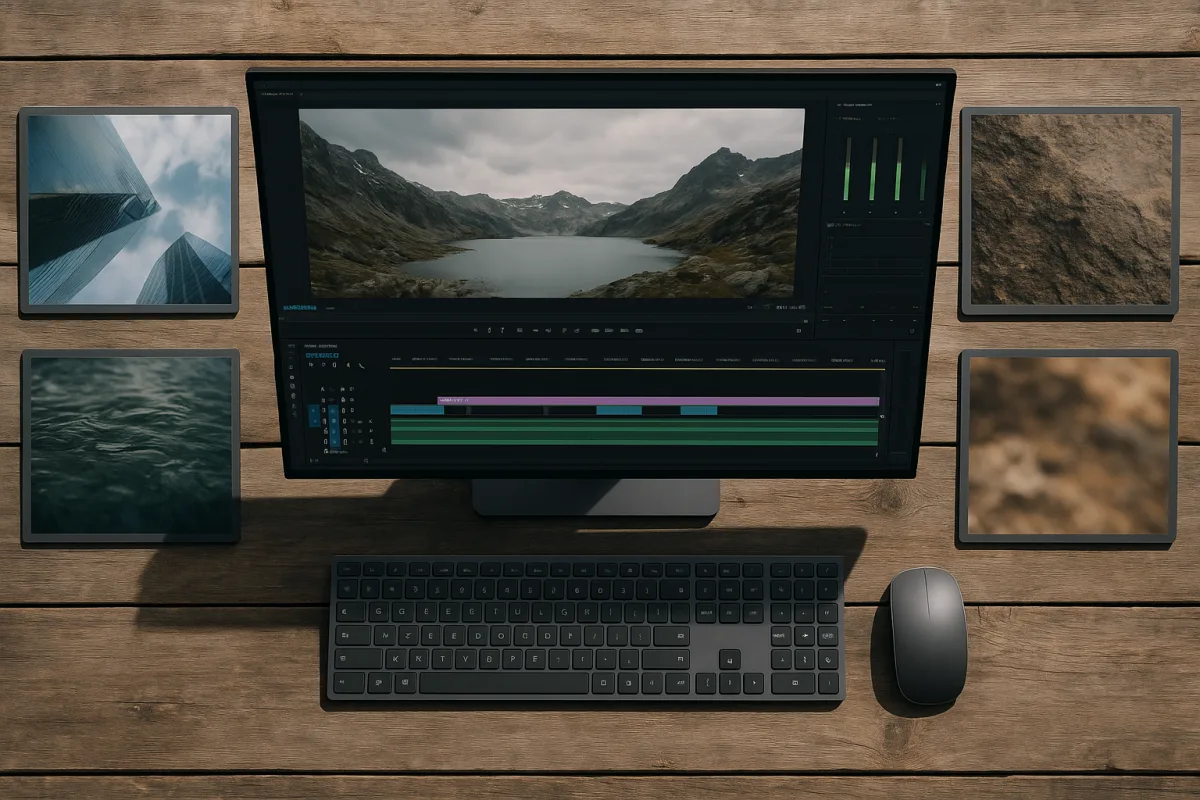
The useful number is not 8K, it is pixels per viewing angle
The best resolution for video is not the format with the biggest number attached. It is the resolution that survives the complete trip from camera to edit system to compression platform to the screen and distance where someone watches it.
That sounds evasive until you look at what resolution actually measures. It is simply the number of pixel samples across and down an image, not a guarantee of detail, sharpness, colour fidelity or clean motion.
A 4K UHD frame is 3840×2160 pixels, or about 8.3 million pixels. An 8K UHD frame doubles both dimensions to 7680×4320, which means roughly 33.2 million pixels, four times as many samples per frame. [13]
That four-times figure is the number that matters in post-production. It explains why 8K does not feel like a small step beyond 4K when you open a project, copy footage, build caches, render effects or make review files.
It also explains why 8K is not automatically four times better to an audience. The viewer does not inspect the file at 100 percent. They see a finite part of the image from a physical distance, through a display with its own limitations.
What the viewer can actually see
Screen size and viewing distance determine whether extra pixels become visible detail. A larger screen fills more of the viewer’s field of vision, while moving farther away makes each pixel occupy a smaller angle in that vision.
SMPTE’s commonly cited 30-degree viewing angle is a useful reference for immersive viewing. On a 65-inch screen, Tom’s Guide calculates that angle at roughly 2.5 metres from the display. [18]
At that distance, 4K is already dense enough for most normal footage. Moving from 4K to 8K may improve a close inspection, but it does not guarantee a visible improvement during ordinary living-room viewing.
Digital Camera World reports that the advantage of 8K on a 75-inch display is only noticeable within about 2.5 feet. [4] That is a plausible technical demonstration distance, but not where most people place a sofa.
Research cited by Tom’s Hardware reaches the same practical point from a different direction. At ten feet from a 50-inch screen, viewers found little perceptual difference across 1440p, 4K and 8K material. [18]
This is why “shoot and deliver the highest resolution possible” is poor deadline advice. If the audience cannot resolve the extra information, you have bought more storage, longer renders and harder playback without making the programme look materially better.
Why 4K is usually the delivery optimum
For most web video, 4K is the sensible ceiling because it preserves detail on large displays, gives online platforms a strong source file and remains manageable for viewers, editors and distributors.
YouTube guidance cited by My Screen Resolution recommends uploading 4K UHD, 3840×2160, for the best quality, even when much of the audience ultimately watches at 1080p. [1]
The important part is not that every viewer receives a 4K stream. Higher-resolution uploads can give the platform a better master to encode into its lower-resolution versions, provided the source is genuinely detailed and not merely upscaled.
That caveat matters. Enlarging a soft 1080p image to 4K creates a 4K file, not 4K picture detail. It can also make compression less efficient by asking the encoder to spend bits describing enlarged noise, sharpening halos or digital texture.
For a finished YouTube programme, 4K is therefore often the best resolution even if acquisition was higher. Capture at 6K or 8K when the edit needs latitude, then make a controlled 4K master rather than treating the camera raster as the delivery requirement.
Broadcast has similar practical constraints. Dacast identifies 1080p as common and 4K UHD as increasingly used, generally in a 16:9 frame, so delivery specifications still matter more than what the camera can record. [7]
Cinema is a separate pipeline with separate raster standards. DCI specifies 2K at 2048×1080, 4K at 4096×2160 and an emerging 8K format at 8192×4320, rather than the consumer UHD dimensions used for television streaming. [13]
Do not mix those labels casually in an export preset. A 4096×2160 DCI file is wider than 3840×2160 UHD, and that difference affects framing, pillarboxing decisions, subtitles, review exports and the deliverable requested by the distributor.
Resolution is also an editing cost multiplier
The 4K-to-8K jump is four times the pixel count before you account for frame rate, bit depth, chroma sampling or codec. A 60fps 8K project is not merely “high resolution”, it is a sustained demand on every part of the workflow.
Storage is the easiest cost to see. Drives Hero estimates 4K ProRes 422 HQ at approximately 3.7GB per minute, while 8K ProRes 422 HQ reaches approximately 14.8GB per minute. [14]
At those rates, an hour of 4K media is about 222GB, while an hour of 8K is about 888GB, before duplicate backups, audio, project files, render caches, exports and the inevitable revised delivery master.
Those numbers are codec-specific, not universal file-size rules. A long-GOP H.264 or H.265 file can be much smaller, but it may ask more of the CPU or GPU because frames are predicted from neighbouring frames instead of stored independently.
Filetoolworks estimates a ten-minute 4K H.264 video at around 3GB to 4GB, compared with roughly 0.8GB to 1GB for a 1080p equivalent. [9] Resolution has a cost even in relatively compressed delivery files.
The workstation impact rises quickly because an editor needs to decode frames, process effects, display an image, cache previews and encode exports. Creative Bloq’s guidance places 4K editing at 16GB RAM or more alongside a capable CPU and GPU. [11]
For 8K, ProStation Systems recommends 128GB to 256GB of RAM and a GPU with at least 12GB of VRAM. [17] Those are workstation-oriented recommendations, not a universal minimum, but they show the scale of the jump.
This is usually where teams misdiagnose a workflow problem as a hardware problem. A machine can be powerful yet still stall on difficult H.265, HEVC or AV1 media, especially when it must decode multiple streams, effects and high-resolution frames simultaneously.
Proxies solve the editorial problem, not the master problem
A proxy workflow separates editing responsiveness from master-image quality. You create smaller, easier-to-decode copies for cutting, then reconnect the edit to original camera files for finishing, colour and final export.
For example, an 8K camera original might be proxied to 1080p or 4K files using an edit-friendly codec. The proxy keeps the same duration, frame rate and timecode, so every cut still points to the correct original frame.
That is why proxies save more time than a speculative computer upgrade on many projects. Scrubbing, multicam playback and basic trims become responsive, while the originals remain available for a full-resolution conform at the end.
The trade-off is management. Someone must generate proxies, keep them linked, maintain sufficient storage for both proxy and original media, and verify that the final export uses originals rather than accidentally rendering the offline copies.
The mechanics differ by NLE, so do not assume that one application’s proxy button describes another application’s behaviour. Some systems switch automatically by playback setting, while others require deliberate relinking or media-management steps before final output.
Proxies are not a cure for bad exposure, missed focus or over-compressed camera footage. They improve editorial performance, not source quality, and they do not remove the need to judge focus, noise and colour on the original-resolution material.
Compression can erase the resolution you paid for
A frame with more pixels needs enough bitrate to describe those pixels. If the encoder does not have sufficient data available, fine detail becomes blocky, smeared or unstable, particularly in foliage, fabric, noise, fast movement and gradients.
StreamingVPS estimates 4K H.264 streaming at about 35Mbps to 68Mbps, while 8K H.265 streaming requires around 50Mbps to 100Mbps. [15] Codec efficiency helps, but it does not make 8K free to distribute.
This is also why an 8K export can look worse than a well-made 4K export at a constrained bitrate. The higher-resolution frame spreads limited data over four times as many pixels, leaving less data available for each part of the image.
H.265, also called HEVC, and AV1 can deliver better compression efficiency than H.264, but compatibility remains uneven across software, hardware and devices. Tom’s Guide notes that the industry transition is still incomplete. [18]
For deadline delivery, compatibility is part of quality. A technically efficient file that fails playback, takes too long to transcode or creates an unpredictable platform result is not the best deliverable, regardless of its resolution label.
Pick resolution from the delivery backwards
Start with the actual destination and its frame shape. Social platforms require their own aspect-ratio rules, with Instagram Stories commonly using a vertical 9:16 format, so a horizontal 4K master is not automatically the right source for every placement. [3]
For vertical social work, the important decision is often framing rather than raw pixel count. A cleanly composed 1080×1920 vertical version can outperform a compromised 4K horizontal crop where faces, captions or product details are poorly positioned.
For standard online programmes, create and archive a quality 4K master when the footage and budget justify it. From that master, make 1080p derivatives for uses where file size, upload time or audience connectivity matters more than pixel density.
Connectivity is not evenly distributed. SpeedtestHQ reports median download speeds of about 480Mbps for higher-income US households, compared with around 85Mbps for lower-income households, alongside a large gap in fibre access. [22]
That does not mean an 85Mbps household cannot watch 4K. It means delivery planning should not assume universal headroom for high-bitrate 4K, much less 8K, especially when several devices share the same connection.
When 8K earns its place
8K acquisition earns its cost when it creates a specific post-production option. The usual cases are a substantial crop into a 4K frame, stabilisation that needs image margins, reframing for multiple aspect ratios, or effects work requiring extra raster.
It can also make sense for a production with a defined high-end cinema, archive or large-display requirement. That is a business and finishing decision, not a general promise that every shot will look better to every viewer.
If none of those uses applies, 4K is normally the quality-preserving choice because it keeps more of the budget available for what audiences notice immediately: controlled lighting, focus, production design, clean sound, colour work and reliable compression.
The practical rule is straightforward: acquire above delivery resolution only when the editorial or finishing plan will spend those extra pixels. Deliver 4K when the platform, audience and bitrate support it, and stop at 1080p when the destination makes that the more reliable image.
Frequently Asked Questions
What is the best resolution for video delivery in 2026?
For most on-demand work in 2026, 4K UHD (3840×2160) is the best resolution to deliver. It balances preserving detail on large displays with manageable workflow and distribution demands. Higher resolutions like 6K and 8K are mainly acquisition formats rather than delivery standards.
How does viewing distance affect the best video resolution?
Viewing distance and screen size determine whether higher resolution improves perceived quality. For example, on a 65-inch screen, a typical viewing distance of about 2.5 meters makes 4K sufficiently detailed. At normal living-room distances, differences between 4K and 8K are often imperceptible.
Why is 4K usually the optimal resolution for video delivery?
4K is optimal because it maintains detail on large screens and provides a strong source for online platforms to encode lower resolutions. Uploading genuine 4K content improves compression efficiency and final quality, whereas simply upscaling lower resolutions to 4K can degrade compression and image quality.
When should I use proxies for high-resolution video editing?
Proxies are recommended when working with high-resolution native media that compromises playback performance. Editors should use proxies during the editorial phase but reconnect to the original camera files before colour grading, exporting, and quality control to ensure final output quality.
What are the workflow costs of editing 8K versus 4K video?
Editing 8K video demands roughly four times the storage and processing resources compared to 4K due to its fourfold increase in pixel count. This significantly increases storage needs, rendering times, and hardware strain, making 8K workflows more costly and less efficient unless specific project needs justify it.
How we researched this
This article was assembled from 23 cited references.
Nothing here is based on hands-on testing. Where a figure or finding appears, it belongs to the source cited beside it, and the writing says so rather than implying otherwise. Every source is listed below so you can check it.
Sources
- What Resolution Should You Upload YouTube Videos In? | My Screen Resolution
- YouTube Video Size (2026): Resolution & Aspect Ratio Guide | Linklay
- Social Media Video Specs for Every Platform | Sprout Social
- Best 8K and 6K camera in 2026: High-resolution video cameras are a step up from 4k
- Video Streaming Resolutions: The 2026 Complete Guide
- Video Resolution Explained: 480p, 720p, 1080p, 4K, 8K (2026 Guide)
- Video Resolution for Streaming in 2026: The Broadcaster's Guide
- Screen Resolution for Video: YouTube, TikTok, Instagram, OBS Settings | screenres.app
- 4K vs 1080p: Resolution, Size, and Quality
- Video Resolution Guide: 720p, 1080p, and 4K
- The best graphics cards for video editing: the best choice for all budgets
- Video Resolution Standards Guide for Professionals
- Video Resolution Explained: 1080p, 4K, 8K Sizes & How to Upscale (2026)
- How Much Storage Do You Need For 4K And 8K Video Editing?
- Can You Stream 8K Video from a VPS? Bandwidth, GPU & Codec Requirements Explained (2026) - StreamingVPS.com
- LaCie 8big Pro5 review: I tested LaCie's huge 256TB DAS solution, and it's ideal for 8K video editing but it comes with a price tag that's just as big
- 4K/8K Video Editing Workstation: The Complete Spec Guide
- I edit video for a living - and this is how much RAM you need in 2026
- 8K Video Processing: Challenges, Practical Solutions & Beginner's Guide - Tech Buzz Online
- Why Everyone's Talking About 8K Video — and Why You Probably Don't Need It Yet - totalmedia.ai
- Editing in 8K: Minimum system requirements - Videomaker
- US connected video devices on course to beat 1.1 billion installed through 2026 | S&P Global
- Best Display Resolution for 4K & 8K Video Editing
Related Articles
Video Editing for Non-Profits: Tips, Tools, and Workflow
Learn video editing for non-profits with tips on timelines, proxies, codecs, and free tools to create effective fundraising and social videos.
Video Editing Techniques for Corporate Videos
Learn effective video editing techniques for corporate videos, including timelines, proxies, codecs, and color grading best practices.
Travel Vlog Video Editing: Workflow, Proxies & Colour Tips
Learn travel vlog video editing with tips on workflow, proxies, colour grading, and pacing to create engaging travel videos efficiently.
Edit Video for Live Events
Learn how to edit video for live events with tips on timelines, proxies, codecs, syncing, and color grading for smooth, efficient post-production.