Best Microphones for Video Production
Compare the best microphones for video production, focusing on DJI Mic 2 and Hollyland Lark M2S for wireless dialogue capture and post-production ease.
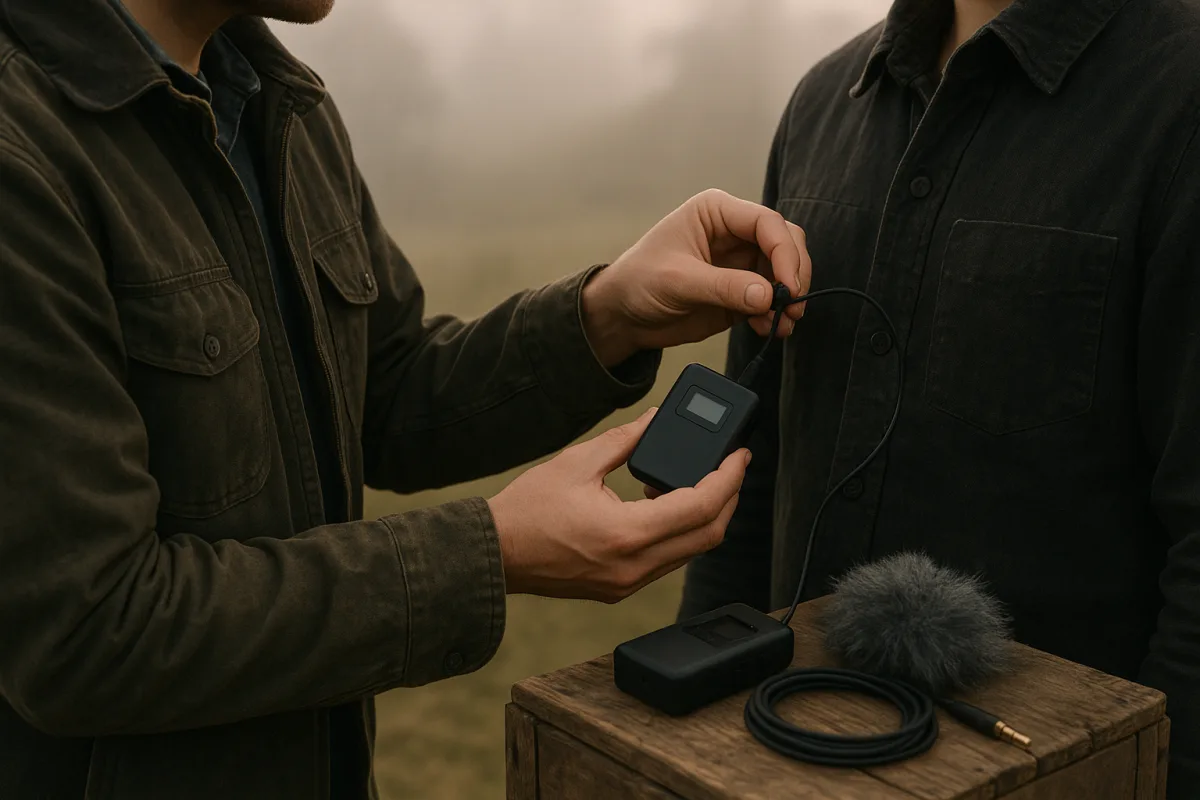
The decision: DJI Mic 2 versus Hollyland Lark M2S
This is a decision between two wireless systems for video dialogue, not a list of every microphone someone might put on a desk. The DJI Mic 2 is the safer choice for productions where post needs insurance. The Hollyland Lark M2S is the tidier choice for creators prioritising small, mobile transmitters.
The choice is close only if you are recording controlled dialogue, setting conservative levels and keeping the subject near the receiver. Once a presenter turns suddenly, moves through a noisy location or speaks unpredictably, the DJI Mic 2’s 32-bit float recording is the more useful distinction. [1]
Neither option automatically makes location sound professional. Wireless solves the problem of getting a microphone close to a moving person. It does not solve wind, room reflections, clothing rustle, RF interference or a poorly placed capsule.
I have not handled or tested either system. This decision rests on the reported features in the research brief and the limits documented for current wireless systems, not on a claim of personal field testing.
The head-to-head comparison
| Criterion | DJI Mic 2 | Hollyland Lark M2S |
|---|---|---|
| Primary video use | Wireless dialogue capture for vloggers and mobile creators who need recording flexibility in post. | Wireless dialogue capture for vloggers and mobile creators who value a compact system for on-the-go work. |
| Recording protection | Supports 32-bit float recording, intended to leave more room for post-production level adjustment when conventional recordings would clip. [1] | The supplied research identifies compact design and dependable wireless use, but does not establish an equivalent 32-bit float safety workflow. |
| Transmitter priority | Better suited to shoots where a louder-than-expected line could otherwise become an unusable take. | Better suited to shoots where physical size and unobtrusive placement matter more than a documented float-recording fallback. |
| Post-production workload | Can reduce rescue work on over-recorded dialogue, although it cannot fix wind distortion, rubbing clothing or a microphone placed too far from the mouth. | Requires the editor to depend more heavily on correct gain staging and clean capture at the location. |
| Wireless limitations | Still subject to interference, battery limits and shorter real-world range than headline line-of-sight figures suggest. | Subject to the same basic wireless constraints, despite its compact format. |
| Latency context | Premium wireless systems can remain below 4 ms, but actual performance depends on the system and environment. [5] | Budget-oriented wireless systems can reach roughly 10 to 20 ms latency, so confirm monitoring and camera-sync behaviour before a live workflow. [5] |
| Best environment | Interviews, walk-and-talks and mobile shoots where the subject may vary in level and retakes are expensive. | Social, vlogging and lightweight mobile shoots where the visual and physical footprint of the transmitter is a major concern. |
| Where it falls down | It is not a substitute for a boom mic in a controlled drama or documentary interview, and its wireless range should not be assumed from marketing specifications alone. | It offers less clearly documented protection for editorial recovery, so it is a weaker fit for uncontrolled, one-chance dialogue. |
| Cost position | Premium tier. | Mid-range tier, below the DJI Mic 2 in the supplied field. |
The DJI Mic 2 wins this specific decision because 32-bit float changes the edit when a take is unexpectedly hot. The feature is not magic. It gives the editor more usable headroom, but only if the recording itself is not wrecked by wind, handling noise or transmission failure.
The Hollyland Lark M2S should not be dismissed because it is smaller or mid-range. A compact transmitter can be the practical answer when wardrobe, movement and speed make a larger system awkward. Its weakness is that the supplied research does not establish the same post-production safety net as the DJI system.
There is no comprehensive 2026 evidence in the brief that directly ranks the sound quality of leading wireless systems beyond their latency and range characteristics. That matters. It would be dishonest to claim that one has categorically better dialogue tone than the other from these sources alone.
Wireless is not the whole audio workflow
Premium wireless can keep latency below 4 ms, while less expensive systems may land around 10 to 20 ms. [5] That is usually not a timeline-sync disaster for recorded interviews, but it matters for live monitoring, live streams and situations where talent hears their own return.
Quoted wireless range is another place where shoots go wrong. Current 2.4 GHz digital systems commonly work around 30 to 80 metres line of sight in practical terms, while UHF analogue can stretch further, up to roughly 150 metres. Walls, bodies and crowded RF environments reduce those figures. [5]
If the subject is static, a wired microphone and balanced XLR connection remain a more predictable professional route. Quality XLR runs up to 10 metres have negligible loss, and well-made cables can remain effective to 50 metres. Longer runs need low-capacitance cable or a snake system. [11]
Avoid building a professional dialogue chain around 3.5mm TRS just because the camera has that socket. It is common in consumer camera workflows but more susceptible to interference than balanced XLR. A clean recording into a proper recorder is easier to cut than a noisy camera track needing repair.
The rest of the field, and where it fits
The supplied field covers more than wireless video microphones, but most alternatives solve different jobs. Their relative cost labels are included because current monetary prices are deliberately excluded here. Product prices change quickly, and the brief specifically does not permit publishing them.
| Product | Relative cost position | What it suits |
|---|---|---|
| Shure MV7+ | Premium | Podcasters and content creators needing USB and XLR connectivity, with a path from simple desktop recording to an XLR setup. [1] |
| Rode NT-USB+ | Premium | Home-studio users wanting plug-and-play voice recording, built-in pop filtering and zero-latency monitoring. [2] |
| Elgato Wave:3 | Premium | Streamers and gamers who need integration with Elgato software controls and want a capacitive mute control. [1] |
| Samson Q2U | Entry-level | Beginners who need USB now but want XLR available when they move to an interface or recorder. [2] |
| FIFINE K690 | Entry-level | New creators needing multiple pickup patterns and headphone monitoring without moving into a more complex audio chain. [1] |
| Razer Seiren V3 Pro | Premium | Streamers and podcasters who value automatic tuning, AI noise removal and Razer’s software-focused feature set. [10] |
| AKG C114 | Premium | Professionals recording vocals or instruments who need a versatile large-diaphragm, multi-pattern condenser. [4] |
| Blue Yeti | Mid-range | Content creators who need selectable pickup patterns and straightforward plug-and-play recording. [9] |
| Maono PD200W | Mid-range | Creators wanting a flexible setup spanning wireless, USB and XLR connectivity. |
| DJI Mic 2 | Premium | Mobile video creators who need wireless dialogue capture and a documented 32-bit float post-production option. [1] |
| Hollyland Lark M2S | Mid-range | Vloggers and mobile creators who need a compact wireless system for portable shooting. |
The Shure MV7+, Rode NT-USB+, Elgato Wave:3, Samson Q2U, FIFINE K690, Razer Seiren V3 Pro and Blue Yeti are principally desktop-oriented choices. They can improve a voiceover, screen recording or talking-head workflow, but USB convenience does not make them the standard choice for professional location production.
The AKG C114 belongs in a different conversation again. Its large-diaphragm, multi-pattern condenser design suits controlled recording of voices and instruments, not the practical problem of wiring a presenter for a moving video shot. [4]
The Maono PD200W is unusual in this field because it is reported to offer wireless, USB and XLR connectivity. That flexibility may suit creators moving between desk recording and video, but the brief provides no comparative evidence that it beats either wireless finalist for location dialogue.
Placement, patterns and environmental fixes
For interviews, microphone placement beats a long spec sheet. Put the capsule close enough to favour the speaker over the room, while keeping it clear of fabric, jewellery and airflow. A lavalier buried under a jacket can create more repair work than an openly placed microphone.
Cardioid microphones focus forward and reduce side and rear noise, though they bring a proximity effect when used very close. Supercardioid patterns reject more side noise but have a rear lobe, so careless placement can capture a camera, a reflective wall or a noisy operator behind the microphone.
Supercardioids also demand more attention outdoors. Under mild to moderate wind, they can be 2 to 5 dB more wind-sensitive than cardioids. That trade-off may be worthwhile in a noisy room, but it is not automatically better for every interview setup.
Wind noise largely occupies the 20 to 200 Hz range. A foam windshield can reduce it by about 6 dB, while a furry windshield can reduce it by more than 20 dB. [7][8] That is a bigger improvement than many editors will get from aggressive dialogue cleanup after the fact.
Use a shock mount where the microphone is on a stand, boom or camera rig, particularly with condensers. Mechanical vibration becomes low-frequency rubbish in the waveform, and it is tedious to remove without thinning the voice or damaging cuts.
For post-production, record a clean reference track to camera when practical, but treat the recorder or wireless receiver as the main dialogue source. Syncing a clean external track is faster than rebuilding a damaged camera recording with denoise, de-rustle and EQ.
Who each option suits
The DJI Mic 2 suits the editor-producer shooting interviews, presentations, walk-and-talks and unscripted material where levels can change before anyone reaches the gain control. Its premium positioning makes most sense when a recovered take is worth more than a smaller initial saving.
The Hollyland Lark M2S suits creators whose work depends on travel, fast setup and discreet equipment. It is the sensible pick when transmitter size is the decisive constraint, provided the crew monitors levels, stays realistic about range and captures a clean take rather than planning to repair everything later.
For fixed voiceovers, podcasts and screen-recorded explainers, choose from the USB and XLR desk microphones in the wider field instead. For professional location work with stationary talent, a properly placed XLR microphone remains the more dependable answer than either wireless option.
Frequently Asked Questions
How does the DJI Mic 2 compare to the Hollyland Lark M2S?
The DJI Mic 2 offers 32-bit float recording, which provides more headroom for post-production level adjustments and better protection against clipped audio. It is better suited for shoots with unpredictable dialogue and fast-moving talent. The Hollyland Lark M2S is more compact and better for mobile shoots prioritizing small transmitter size but lacks the same documented recording protection, making it less ideal for one-chance dialogue.
When should I use wireless vs wired microphones for video?
Wireless microphones are best when mobility and freedom of movement are essential, such as live events, walk-and-talks, or mobile shoots. Wired microphones with balanced XLR connections remain more professional and predictable for fixed indoor voice recording, offering negligible signal loss over typical cable lengths and avoiding wireless interference and latency issues.
What microphone features help reduce post-production audio work?
Features like 32-bit float recording, as found in the DJI Mic 2, can reduce rescue work on over-recorded dialogue by providing more usable headroom. However, proper microphone placement, wind protection, and monitoring usually save more editing time than relying on microphone features alone. Wireless systems cannot fix issues like wind noise, clothing rustle, or poor mic placement.
Which microphones are best for mobile and on-the-go video shoots?
Compact wireless systems like the Hollyland Lark M2S are well suited for creators who prioritize small, unobtrusive transmitters for social, vlogging, and lightweight mobile shoots. The DJI Mic 2 is also a strong choice when recording flexibility and post-production safety are important, especially in less controlled environments.
How we researched this
This article was assembled from 11 cited references.
Nothing here is based on hands-on testing. Where a figure or finding appears, it belongs to the source cited beside it, and the writing says so rather than implying otherwise. Every source is listed below so you can check it.
Sources
- Best Microphones 2026 for Streaming and YouTube: USB, XLR, Lavalier
- Best Microphones for YouTube, Podcasting & Voiceovers in 2026 – AI Video Advisor
- 6 Best Wireless Microphones for Video Production (September 2026) Honest Reviews
- Best USB microphones 2026: Plug-and-play mics for everything from streaming to singing
- Wireless Microphones Guide: Types, Specs & Setup (2026)
- Saramonic Air SE review: a compact 'plug and play' wireless mic set
- Effective Wind Protection | SCHOEPS Microphones
- Why Do Microphones Have Fur? Wind Noise Explained - ScienceInsights
- The best microphones in 2026: boost voice quality at home
- The Seiren V3 Pro proves Razer can build a true studio-grade mic, and it might be the company's most mature product yet
- Audio Systems Guide for Video and Film Production
Related Articles
Best Cameras for Video Production 2026
Compare the best cameras for video production in 2026, focusing on Sony FX6 and Panasonic Lumix S1R II features, codecs, and post-production workflows.
Best Video Editing Software for Mac
Compare Final Cut Pro 10.6 and DaVinci Resolve 18 to find the best video editing software for Mac users focused on Apple Silicon and 4K workflows.
Travel Vlog Video Editing: Workflow, Proxies & Colour Tips
Learn travel vlog video editing with tips on workflow, proxies, colour grading, and pacing to create engaging travel videos efficiently.
Handling Client Feedback in Video Editing: Best Practices
Learn how to handle client feedback in video editing with clear processes, tools, and strategies to avoid endless revisions and streamline approvals.